Rio de Janeiro · Samba Schools & Their Communities
Rio Samba Schools: Famous Schools, Rehearsals & Culture
Meet the samba schools behind Rio’s Carnival. Discover the identities and home communities of the 12 Special Group schools for 2027, find their rehearsal venues and learn how visitors can experience a genuine samba-school event beyond the parade.
The Institutions Behind Carnival
What Is a Samba School in Rio de Janeiro?
A Rio samba school is a community-based cultural association that organizes music, dance, artistic production and an annual Carnival parade. It is not simply a business offering samba dancing lessons.
In Portuguese, these organizations are called escolas de samba. Many use the abbreviation G.R.E.S., meaning Grêmio Recreativo Escola de Samba.
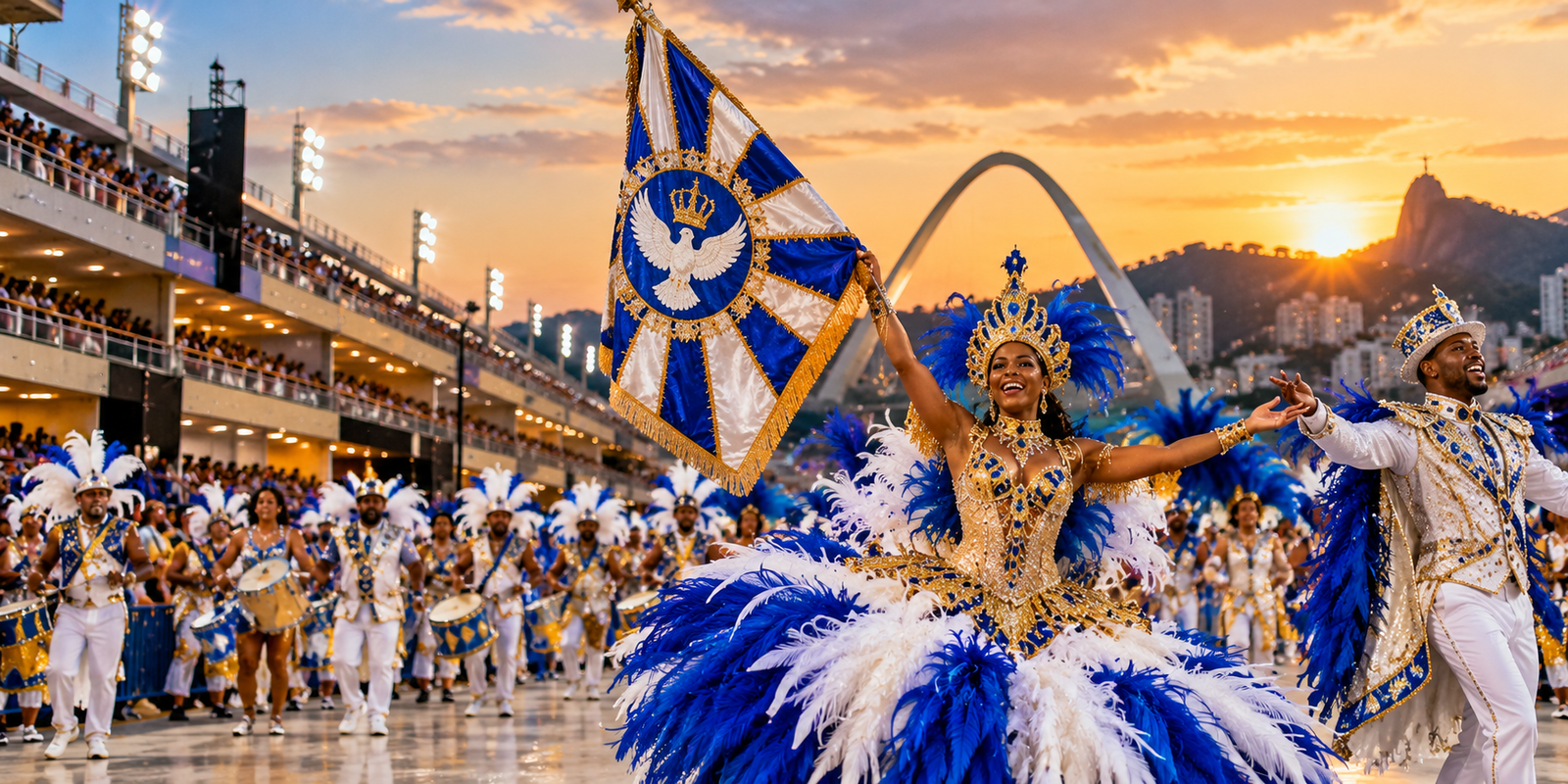
Each school has its own name, colors, emblem, flag, community identity, musical traditions and organizational structure. Supporters commonly identify strongly with a school, much as they might support a football club.
Schools are rooted in neighborhoods, communities and municipalities across Greater Rio. Some are associated with famous areas such as Mangueira, Madureira and Vila Isabel, while others represent places beyond the municipal boundary of Rio, including Nilópolis, Duque de Caxias, Niterói and Maricá.
The parade visible at the Sambadrome is the result of extensive preparation. Composers, percussion musicians, costume designers, carpenters, performers, choreographers, artists and community volunteers contribute to each annual production.
A samba school is therefore both a competitive Carnival organization and a cultural institution with activities extending beyond the parade itself.
Community & Tradition
A school’s history is closely associated with its supporters, territory, musicians and Carnival heritage. Its colors and flag are symbols of belonging, not seasonal decorations.
Music & Artistic Work
Each year’s project involves selecting a narrative, composing a samba-enredo, designing costumes, rehearsing performers and constructing the visual elements of the parade.
Championship & Divisions
Schools compete within organized divisions and are assessed under formal judging regulations. Their position can change through promotion and relegation.
Rio Carnival 2027
The 12 Special Group Samba Schools in 2027
Rio’s Special Group, or Grupo Especial, contains 12 schools for Carnival 2027. This list identifies the schools by their community origins, institutional colors and founding years, rather than repeating the parade timetable.
| School | Community / City | Colors | Founded |
|---|---|---|---|
| Portela | Madureira, Rio | Blue and white | 1923 |
| Estação Primeira de Mangueira | Mangueira, Rio | Green and pink | 1928 |
| Unidos da Tijuca | Tijuca, Rio | Blue and yellow | 1931 |
| Unidos de Vila Isabel | Vila Isabel, Rio | Blue and white | 1946 |
| Unidos do Viradouro | Niterói | Red and white | 1946 |
| Beija-Flor de Nilópolis | Nilópolis | Blue and white | 1948 |
| Paraíso do Tuiuti | São Cristóvão, Rio | Blue and yellow | 1952 |
| Acadêmicos do Salgueiro | Andaraí / Salgueiro, Rio | Red and white | 1953 |
| Mocidade Independente de Padre Miguel | Padre Miguel, Rio | Green and white | 1955 |
| Imperatriz Leopoldinense | Ramos, Rio | Green, white and gold | 1959 |
| Acadêmicos do Grande Rio | Duque de Caxias | Red, green and white | 1988 |
| União de Maricá | Maricá | Red, gold and white | 2015 |
The exact dates, running positions and announced parade themes of these schools are covered in the separate Rio Carnival 2027 programme.
Know the Schools
Famous Rio Samba Schools and Their Identities
The schools differ in age, community background, musical heritage and competitive history. Their identities remain distinct even when they compete under the same Carnival regulations.
Portela
Founded in 1923, Portela is the oldest of the 12 schools competing in the 2027 Special Group. Its identity is strongly connected with Madureira and Oswaldo Cruz, two important areas in Rio’s samba tradition.
Portela is recognized by its blue-and-white colors and eagle emblem. It has an especially important place in the development of samba-school music and Carnival tradition.
Estação Primeira de Mangueira
Mangueira was founded in 1928 and is immediately recognizable by its green-and-pink colors. Its musical and cultural identity is closely tied to the Mangueira community and its samba heritage.
The school has a longstanding tradition of influential composers, singers and community performers. Its name is inseparable from the cultural history of samba in Rio de Janeiro.
Beija-Flor de Nilópolis
Beija-Flor was founded in 1948 and represents Nilópolis, a municipality in the Baixada Fluminense. Its blue-and-white colors distinguish it from the similarly colored Portela and Vila Isabel.
The school is widely associated with ambitious theatrical presentations and a strong competitive tradition. Its home identity belongs to Nilópolis rather than a neighborhood within Rio city.
Acadêmicos do Salgueiro
Salgueiro was founded in 1953 and wears red and white. Its origins are associated with the Salgueiro community in Rio’s North Zone.
The school has been particularly influential in presenting Afro-Brazilian historical and cultural subjects through Carnival. Its performance identity combines percussion, choreography and narrative.
Mocidade Independente de Padre Miguel
Established in 1955, Mocidade represents the Padre Miguel community in Rio’s western area. Its colors are green and white.
The school is especially associated with a powerful percussion tradition and musical experimentation. The bateria has been central to Mocidade’s identity across generations.
Imperatriz Leopoldinense
Founded in 1959, Imperatriz Leopoldinense is associated with Ramos in Rio’s North Zone. Its institutional colors are green, white and gold.
Imperatriz has a strong competitive history and a reputation for detailed parade construction. The school is an important cultural institution in the Ramos community.
Unidos de Vila Isabel
Founded in 1946, Vila Isabel is associated with the neighborhood of the same name. Its colors are blue and white.
The neighborhood has a particularly strong musical tradition, and the school is closely connected with samba composer Martinho da Vila. Its identity reflects that artistic heritage.
Paraíso do Tuiuti
Paraíso do Tuiuti was founded in 1952 and is identified with São Cristóvão, in Rio’s North Zone. Its colors are blue and yellow.
The school has earned recognition for parades addressing historical, cultural and social subjects. Its 2018 presentation on slavery and its legacy became one of the school’s especially notable productions.
Unidos da Tijuca
Unidos da Tijuca was founded in 1931 and has blue-and-yellow institutional colors. It developed from the Tijuca area and is known for elaborate theatrical parade presentations.
Its rehearsal arrangements have involved venues in the port region. A new rehearsal hall in Gamboa was announced in 2026, so visitors should confirm the current event location rather than relying on an older address.
Unidos do Viradouro
Founded in 1946, Viradouro represents Niterói, the city across Guanabara Bay from Rio de Janeiro. Its colors are red and white.
Viradouro has established itself as an important Special Group competitor, with strong musical, visual and theatrical parade traditions.
Acadêmicos do Grande Rio
Grande Rio was founded in 1988 and represents Duque de Caxias, another municipality within Greater Rio. The school’s colors are red, green and white.
Its Carnival identity combines community representation from Baixada Fluminense with large-scale productions for the Special Group competition.
União de Maricá
União de Maricá was founded in 2015 and represents the municipality of Maricá, east of Rio. Its colors are red, gold and white.
The school is a newer institution than the established Special Group names. Its promotion into the 2027 division represents an important stage in its development.
Behind the Annual Production
How Do Rio Samba Schools Prepare for Carnival?
The Carnival parade is the final public presentation of a creative process that involves music competitions, rehearsals, costume production, float construction and coordinated community work.
Choosing the Enredo
The enredo is the central theme or story of a school’s next parade. It provides the artistic direction for the production.
The theme may involve historical personalities, cultural traditions, literature, mythology, social questions or other subjects developed by the school’s creative team.
Selecting the Samba-Enredo
The samba-enredo is the song created for that year’s theme. Composer partnerships often compete in a series of selection rounds before the school chooses the winning composition.
These competitions can take place in the school’s quadra and may be open to paying spectators, supporters and members under the event’s admission arrangements.
For Carnival 2027, the Special Group’s samba-enredo finals took place during August and September 2026.
Building Floats and Costumes
Artists, sculptors, carpenters, metalworkers, painters and costume specialists produce the visual elements of the parade.
The main Special Group production workshops are concentrated at Cidade do Samba, in Gamboa. They are different from the neighborhood rehearsal halls.
Rehearsing the Community
Schools bring together percussion musicians, dancers, wing participants, interpreters and their organizational teams.
Community rehearsals prepare participants to sing the samba-enredo, maintain formations and perform their assigned roles.
Technical Preparation
Schools rehearse movement, music, timing and formation before the competition.
Technical rehearsals at the Sambadrome allow adjustments along the actual parade route. These differ from the musical events held inside a school’s quadra.
Experience Samba Outside the Parade
Can Tourists Attend Rio Samba School Rehearsals?
Yes. Many samba schools organize public rehearsals, samba nights and other cultural events where visitors can experience their music and community atmosphere. However, not every rehearsal is open to the public.
Visitors should distinguish between four different types of samba-school activity before deciding which event to attend.
Rehearsal Hall Events
Held in a school’s main event or rehearsal venue. These evenings may feature the bateria, singers, dancers and community participants performing the school’s repertoire.
Some are open to the general public with paid admission, while others follow different participation arrangements.
Street Rehearsals
Street rehearsals allow a school to practise along a public route, with organized groups moving together.
Locations can be connected with the school’s own neighborhood. Street closures, meeting points and schedules vary between events.
Sambadrome Technical Rehearsals
Technical rehearsals use the actual Sambadrome parade avenue. They help schools refine timing, movement and singing before the competition.
Public technical rehearsals have traditionally offered free admission. Specific dates, access sectors and opening arrangements depend on the edition.
Song Selection Events
A samba-enredo final is the culminating stage of the school’s annual song competition.
Composer partnerships present their entries before the school makes its selection. These events take place well before the main Carnival competition.
Know the Right Venue
Quadra, Barracão and Cidade do Samba: The Difference
One of the most important practical distinctions for visitors is that a samba school’s performance venue, administrative headquarters and production workshop are not necessarily in the same place.
Rehearsal & Community Venue
A quadra is where a school holds rehearsals, cultural events, samba evenings and community gatherings.
This is generally the relevant location when a visitor wants to attend a public samba-school rehearsal.
Production Workshop
A barracão is the working space where the artistic team constructs or prepares floats, scenery and costumes.
These are active production areas. Public access should not be assumed without a specifically authorized visit.
Special Group Production Complex
Cidade do Samba Joãosinho Trinta is located at Rua Rivadávia Corrêa, 60, Gamboa, in Rio’s port region.
The complex houses workshops used by Special Group schools. Public events may be held there, but access to those events is different from unrestricted access to workshops.
Where Are Samba School Quadras Located?
Rio’s rehearsal venues are spread across the city and its surrounding municipalities. They are not concentrated around Copacabana, Ipanema or the Sambadrome.
Portela, Mangueira, Salgueiro, Vila Isabel, Imperatriz and Tuiuti have venues associated with neighborhoods in Rio’s North Zone.
Mocidade’s listed quadra is in Realengo, in the city’s western area. Beija-Flor is based in Nilópolis, Grande Rio in Duque de Caxias, Viradouro in Niterói and União de Maricá in Maricá.
These geographical differences matter when choosing a rehearsal to attend. The event address should be identified before planning the journey, particularly for schools outside Rio municipality.
Visiting a Samba School
How to Attend a Genuine Samba School Event
For visitors interested in samba-school culture, an advertised public event at a quadra offers a different experience from watching a competitive parade at the Sambadrome.
Choose a School and Event
Decide whether you want a quadra rehearsal, samba-enredo selection event, public street rehearsal or technical rehearsal.
Do not assume that a school hosts a public performance every evening.
Confirm the Venue
Check the announced event location rather than relying only on the school’s historical neighborhood or administrative address.
Some institutions use alternate venues, and arrangements can change between events or seasons.
Check the Admission Arrangement
Quadra nights may require paid admission, advance registration or a particular event ticket.
Free public technical rehearsals operate under different access arrangements.
Understand the Nature of the Event
A quadra evening often involves music, singing, dancing and a lively community gathering.
It is not necessarily a staged tourist show with fixed seating or a formal sequence of performances.
Plan the Return Journey
Events can extend late into the evening. Establish the expected finishing arrangements and your return transport before traveling, especially when visiting a municipality outside central Rio.
Taking Part in Carnival
Can Tourists Join a Rio Samba School?
Participation is possible in some circumstances, but attending a rehearsal, joining an association and performing in a competitive parade are different activities.
Some samba schools offer opportunities for participants to parade in particular costume wings, subject to the school’s arrangements.
These opportunities may require advance registration, costume acquisition, attendance at rehearsals or fulfillment of the school’s participation conditions.
A place in the bateria, as a passista or in a specialized performance section is not equivalent to buying a spectator ticket or an ordinary costume package.
Spectator Admission
A Sambadrome ticket provides access to the selected viewing area. It does not give permission to enter the parade avenue as a performer.
School Participation
Participation requires a separate arrangement with the school or an authorized provider of costume-wing participation.
The participant must follow the school’s instructions concerning costume use, meeting points and parade conduct.
Understanding Rio Carnival Culture
What Is the Difference Between a Samba School and a Bloco?
A samba school and a street Carnival bloco are not the same type of organization or public event.
| Feature | Samba School | Street Bloco |
|---|---|---|
| Organization | Cultural association with an established community identity | Street Carnival group or procession organizer |
| Main activity | Preparing and presenting samba-school Carnival performances | Organizing public street-Carnival celebrations |
| Competition | Competes within organized divisions when registered for competitive parades | Generally not part of the formal samba-school championship |
| Music | Samba-enredo and the school’s musical repertoire | Varies according to the bloco’s musical identity |
| Visitor experience | Parade attendance, public rehearsals and quadra events | Street gatherings and moving outdoor processions |
Rio’s street Carnival has its own traditions, organizers and neighborhood events. Explore those in the Rio Street Carnival and Blocos Guide.
Questions About Rio Samba Schools
Frequently Asked Questions
How many samba schools are in Rio Carnival?
Many samba schools participate across different Carnival divisions and competitions. The highest division, Grupo Especial, contains 12 schools for Carnival 2027. This is not the total number of samba schools in Greater Rio.
Which is the oldest Rio samba school?
Portela, founded in 1923, is the oldest school in the 2027 Special Group. The broader history of Rio’s earliest samba-school institutions is more complex and includes organizations outside the current division.
Is Mangueira a samba school or a neighborhood?
Both names are used. Mangueira is a community in Rio de Janeiro, while Estação Primeira de Mangueira is the samba school associated with that community.
Are all samba schools based in Rio city?
No. Beija-Flor represents Nilópolis, Grande Rio represents Duque de Caxias, Viradouro represents Niterói, and União de Maricá represents Maricá. These municipalities are outside the city of Rio de Janeiro.
Can tourists attend samba school rehearsals?
Yes, when a school advertises a public event. Admission may be free, paid or subject to registration, depending on the rehearsal. Not every internal rehearsal is open to visitors.
Do samba schools rehearse all year?
Schools operate beyond the Carnival period, but their public event and rehearsal schedules change throughout the year. Major samba-enredo selection events and parade rehearsals are concentrated in particular phases of Carnival preparation.
What is a samba school quadra?
A quadra is the school’s rehearsal and community event venue. It may host samba nights, song competitions, rehearsals and social gatherings. It is distinct from the production workshop known as a barracão.
Can visitors enter Cidade do Samba?
Cidade do Samba hosts public events on selected occasions, but visitors should not assume unrestricted entry into the production workshops. Access depends on the activity and authorized admission arrangements.
Can foreigners participate in a samba school parade?
Foreign visitors may participate through appropriate school arrangements where places are offered. Requirements can include costume acquisition, registration, rehearsals and participation rules. Spectator admission alone is insufficient.
What does samba-enredo mean?
Samba-enredo is the song composed for a school’s annual parade theme. It provides the principal musical narrative used throughout the Carnival presentation.
Explore More of Rio Carnival
Continue Exploring Samba and Carnival
Learn about the competitive parades, the annual programme, Carnival traditions and the practical arrangements for visiting Rio.