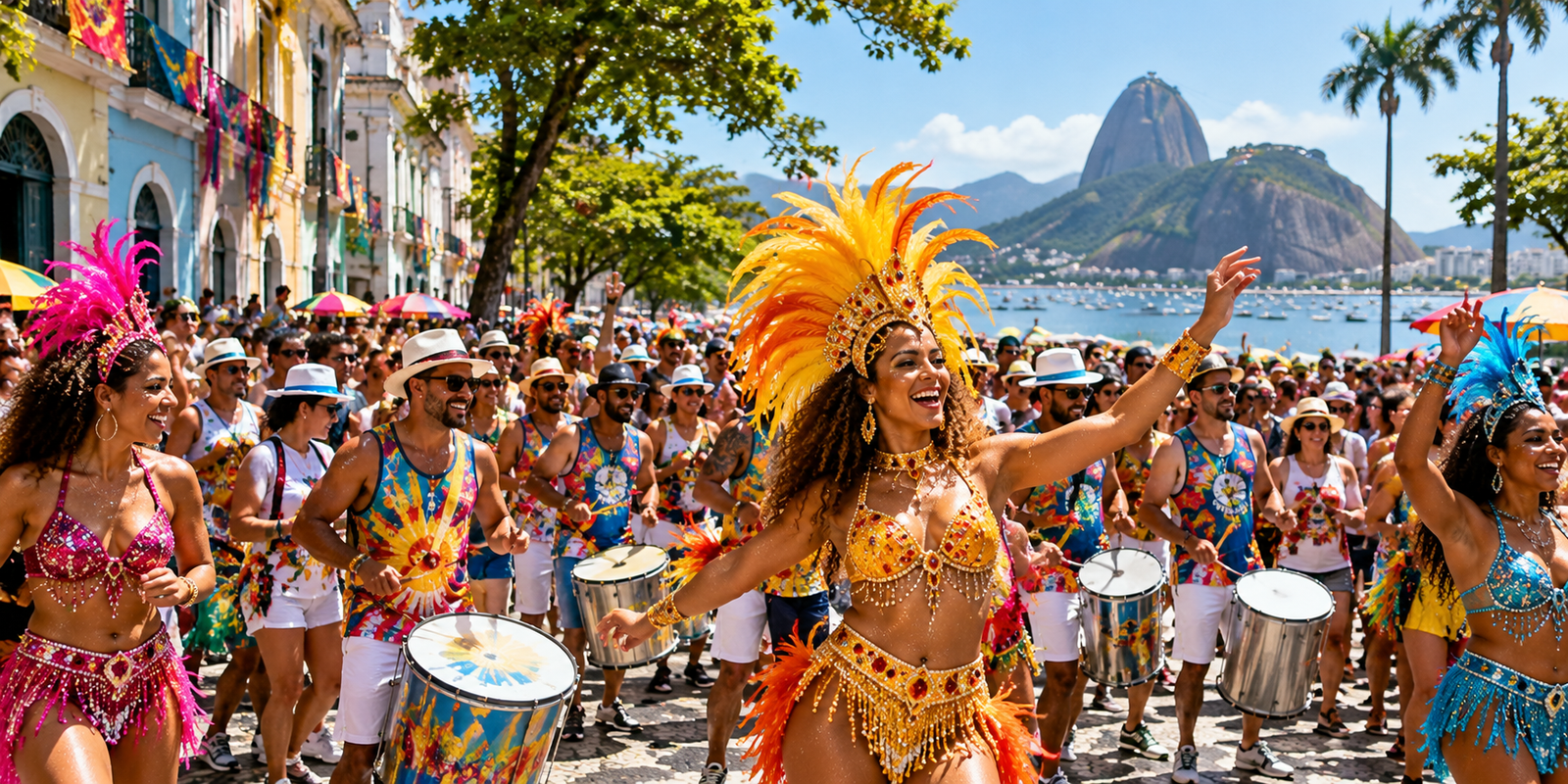
Carnaval de Rua · Rio de Janeiro
Rio Street Carnival: Blocos, Neighborhoods & Local Guide
Experience Rio Carnival on the streets through traditional marching bands, percussion groups, neighborhood processions and enormous megablocos. Discover the city’s best-known blocos, understand where they usually perform, and learn how to plan around the 2027 street Carnival season.
Understanding Rio’s Street Celebrations
What Is a Rio Carnival Bloco?
A bloco de rua is an organized street Carnival group that brings music, dancing and costumed participants into public spaces. Some move through neighborhood streets, while others perform along larger routes or gather around a designated location.
The people attending are commonly called foliões — Carnival revelers. An individual procession is a desfile or cortejo, while the gathering before it starts is known as the concentração.
The defining feature of street Carnival is that the celebration takes place in the city itself. Participants gather on streets, squares and avenues, often following live percussion or a mobile music platform.
A bloco does not necessarily have floats, grandstands, numbered seating or a fixed performance schedule. The experience differs considerably from the competitive samba-school parades held inside the Sambadrome.
Rio’s street Carnival includes traditional samba groups, marching bands playing Carnival marchinhas, brass orchestras, Afro-Brazilian percussion traditions and contemporary musical interpretations.
Two blocos taking place on the same morning can offer very different experiences. One might be a tightly packed megabloco in central Rio, while another could be a moving neighborhood procession with a traditional orchestra.
Neighborhood Blocos
Groups closely associated with particular neighborhoods, musical traditions and long-established Carnival communities.
Their routes can involve ordinary residential streets and local squares.
Megablocos
Large public street celebrations requiring extensive crowd management, road closures and specially planned routes.
They can attract very large crowds and significantly affect movement through central Rio.
Orchestras & Themed Blocos
Street groups built around brass music, percussion, Carnival classics or particular musical themes.
Their musical identity can be a better guide to the experience than the size of the crowd.
Rio Street Carnival 2027
When Does Rio Street Carnival Start in 2027?
Rio’s 2027 street Carnival season is planned to begin on Saturday, 16 January 2027. This opening date is distinct from the main February Carnival celebration.
The municipal registration process for 2027 blocos opened on 24 August 2026 and closed on 24 September. Registration is the first stage of event authorization; it does not by itself establish that a bloco has received permission to perform at a requested location and time.
As of 13 October 2026, municipal review of the registered proposals is still underway. The planned administrative timetable includes preliminary decisions, additional security documentation and final registration procedures concluding in January 2027.
Therefore, the planned 16 January opening should not be mistaken for a finalized list of individual bloco performances.
What Does the Approval Process Mean for Visitors?
Bloco Registration
Organizers submit intended event details. A registered proposal is not a confirmed public procession.
Review & Documentation
Municipal bodies assess proposals and organizers complete applicable authorization requirements. Routes and permissions can change during this process.
Final Event Confirmation
The administrative timetable provides for completion of final documentation before the planned street Carnival opening.
Rio’s Recognizable Street Carnival Groups
Famous Rio Carnival Blocos Worth Knowing
The following groups represent different styles of street Carnival. Some are known for traditional orchestras, others for their neighborhood identity, enormous crowds or distinctive musical arrangements.
Large-scale traditional bloco
Cordão da Bola Preta
Cordão da Bola Preta is one of the oldest and most recognizable names in Rio’s street Carnival, established in 1918.
The group’s visual identity is closely associated with black-and-white clothing and its traditional black-dot motif. It is famous for enormous crowds, Carnival songs and a highly energetic public celebration.
In 2026, its main procession occupied the central-city parade circuit around Avenida Presidente Antônio Carlos.
Traditional orchestra
Cordão do Boitatá
Cordão do Boitatá is known for its acoustic street orchestra, traditional Carnival repertoire and elaborate costumed participation.
Its musical character distinguishes it from megablocos that depend on large amplified sound trucks. The orchestra brings together instrumentalists performing marchinhas, samba and other Carnival music.
In 2026, the group marked its thirtieth anniversary and returned to the Rua Primeiro de Março area for its procession. It also held a major Carnival celebration at Praça XV.
Percussion megabloco
Monobloco
Monobloco is one of Rio’s best-known contemporary percussion groups, associated with musician Pedro Luís and its distinctive percussion arrangements.
Its repertoire combines rhythms and songs drawn from several Brazilian musical traditions rather than following only a conventional samba-school format.
Monobloco closed Rio’s 2026 street Carnival programme with a large morning event in the Centro, along the Circuito Preta Gil.
Neighborhood tradition
Simpatia É Quase Amor
Simpatia É Quase Amor is a longstanding Ipanema Carnival bloco founded in 1985. It is associated with colorful street celebrations, lively music and an expressive neighborhood identity.
The group has a tradition of social commentary, Carnival humor and topical themes. Its character differs from the central-city megablocos.
For one of its 2026 events, the gathering point was Praça General Osório in Ipanema.
Historic Carnival band
Banda de Ipanema
Founded in 1965, Banda de Ipanema is a historic Carnival institution closely connected with the identity of the neighborhood.
Its processions celebrate Carnival music, costumes, humor and the area’s inclusive street culture.
Praça General Osório is closely associated with the Banda’s historic presence in Ipanema. The actual gathering point must still be checked for each edition.
Marching orchestra
Céu na Terra
Céu na Terra is strongly connected to Santa Teresa, the hillside neighborhood known for its historic streets and artistic community.
The group performs traditional Carnival music with a colorful orchestra, elaborate costumes and an energetic procession atmosphere.
In 2026, one of its events gathered around Rua Almirante Alexandrino, 89, in Santa Teresa.
Traditional neighborhood bloco
Bloco das Carmelitas
Carmelitas is one of the Carnival traditions associated with Santa Teresa. The bloco’s name draws on the neighborhood’s Carmelite convent tradition.
Its costumed procession winds through the streets of Santa Teresa, combining classic marchinhas, samba and neighborhood participation.
During Carnival 2026, the official event listing included a gathering at Largo do Curvelo.
Themed musical bloco
Bloco do Sargento Pimenta
Sargento Pimenta is especially recognizable for combining songs by the Beatles with Brazilian Carnival percussion and street-band arrangements.
Its performances demonstrate how Rio’s bloco culture adapts international popular music into local rhythmic traditions.
The group performed at the Aterro do Flamengo during Carnival 2026.
Neighborhood procession
Bloco do Barbas
Bloco do Barbas is associated with Botafogo and has a long-established neighborhood Carnival tradition.
It is particularly recognizable for its relaxed, playful Carnival atmosphere and its well-known use of water during celebrations.
The 2026 event listing identified Rua Arnaldo Quintela in Botafogo as its gathering area.
Percussion and mixed repertoire
Bangalafumenga
Bangalafumenga combines energetic percussion and a varied musical repertoire, drawing on different popular Brazilian rhythms.
The group’s live percussion and contemporary musical identity make it distinct from a strictly traditional marchinha orchestra.
In 2026, Bangalafumenga returned to Rio’s street Carnival programme with a celebration in the Glória area.
Understanding Street Carnival Geography
Where Does Rio Street Carnival Take Place?
Street Carnival is spread across Rio de Janeiro. Each neighborhood creates a different setting, and the character of the celebration depends as much on the bloco as on the location.
Large Events and Traditional Music
The Centro is an important setting for megablocos, historic Carnival groups and major street celebrations.
The central route around Rua Primeiro de Março and Avenida Presidente Antônio Carlos hosted large-scale events in 2026.
The area can experience extensive temporary road closures and high pedestrian density. A public transport plan is particularly important for these events.
Established Neighborhood Blocos
Ipanema is closely associated with Banda de Ipanema and Simpatia É Quase Amor.
Praça General Osório has historically been an important meeting area for these celebrations.
Streets can become extremely crowded during major events, even though Ipanema has several metro connections nearby.
Traditional Processions on Hillside Streets
Santa Teresa provides a very different setting from a wide city-center avenue.
Blocos such as Céu na Terra and Carmelitas have long associations with the neighborhood.
Narrow streets, steep slopes, limited vehicle access and large crowds make route planning especially important.
Neighborhood Events and Open-Space Music
The Botafogo, Glória and Flamengo areas host a range of neighborhood and themed Carnival events.
Bloco do Barbas has a strong Botafogo identity, while Sargento Pimenta has performed at the Aterro do Flamengo.
The terrain and crowd arrangements vary significantly between a residential street and the broad parkland of the Aterro.
Community-Based Carnival Traditions
Neighborhoods such as Ramos, Madureira and surrounding North Zone districts have important samba and Carnival traditions.
Cacique de Ramos, for example, is a historic cultural institution associated with the Ramos area.
These celebrations offer a different geographical perspective from the tourist neighborhoods of the South Zone.
Local and Community Blocos
Street Carnival also takes place in West Zone neighborhoods, including areas such as Bangu, Campo Grande and Santa Cruz.
These are not secondary versions of the Centro megablocos. Many have their own local organizers, community traditions and event arrangements.
Visitors should plan transport around the actual authorized event, rather than assume every bloco is accessible from the beach districts on foot.
Compare Street Carnival Experiences
Which Rio Carnival Bloco Should You Attend?
The right bloco depends on your interest in music, crowd size, movement, local traditions and the physical conditions of the route. The most famous event is not necessarily the most suitable for every visitor.
| Visitor interest | Blocos to explore | Important consideration |
|---|---|---|
| Traditional Carnival music | Cordão do Boitatá, Céu na Terra | Look for orchestra-led events and live marchinha performances. Routes may be crowded. |
| Very large crowds | Cordão da Bola Preta, Monobloco | Expect extensive street restrictions, dense crowds and limited mobility near the main event. |
| Traditional Ipanema culture | Banda de Ipanema, Simpatia É Quase Amor | Confirm each event’s route and gathering point separately. |
| Historic hillside setting | Carmelitas, Céu na Terra | Santa Teresa’s narrow, sloping streets can make crowded movement difficult. |
| Contemporary musical arrangements | Sargento Pimenta, Bangalafumenga | Musical repertoire differs from conventional Carnival marchinhas and samba. |
| Neighborhood atmosphere | Bloco do Barbas and smaller authorized local blocos | Compare the particular event’s expected scale, location and public access. |
Should First-Time Visitors Choose a Megabloco?
A megabloco can be an unforgettable experience, but its atmosphere depends heavily on the size and density of the crowd.
Large events can occupy several connected streets. Visitors may not be able to reach the musical performers closely or move freely between different sections of the crowd.
For a first street Carnival experience, a smaller authorized procession with a manageable gathering area may make it easier to understand the music, costumes and participation without having to navigate a major crowd.
If the central purpose of your visit is experiencing one of Rio’s largest public celebrations, choose a megabloco deliberately and plan accordingly.
Understanding the Schedule
How to Find and Attend a Rio Street Bloco
A street-bloco listing has several distinct pieces of information. Understanding them prevents some of the most common arrival mistakes.
Confirm the Date and Authorization
Begin with the authorized programme for the correct Carnival year. A route appearing in an older article or video is not necessarily valid for 2027.
A popular bloco can change its meeting point, procession route or event date between editions.
Identify the Concentração
Concentração is the designated gathering phase before the procession begins.
It can take place before the announced start of the parade. The crowd may already be substantial by the time the group starts moving.
Understand the Route
Some blocos move through several streets, while others perform in a more fixed public space.
Check whether the advertised location refers to the starting point, the general route or the ending area.
Choose a Practical Arrival Point
Do not assume a taxi can reach the exact gathering point. Temporary vehicle restrictions often begin before the procession.
Plan where to approach the event on foot and identify a sensible exit away from the main crowd.
Check the Dispersal Arrangements
Dispersão is the phase in which the procession ends and the crowd begins to leave.
The departure area may be far from the original gathering location. Avoid planning an immediate vehicle pickup at the center of dispersing crowds.
Moving Around Rio During Street Carnival
Getting to Blocos: Metro, Walking and Road Closures
Street Carnival temporarily changes the way parts of Rio de Janeiro function. The most efficient route during an ordinary weekday may not be available on a major bloco day.
Temporary restrictions affect the gathering area, the procession route and sometimes neighboring streets used for crowd dispersal or emergency access.
Metro and VLT
Central Rio has metro and VLT light-rail connections that can be useful for major street events.
Stations such as Carioca, Cinelândia and Uruguaiana may be relevant, depending on the exact route and event-day restrictions.
Metro to the Neighborhood
General Osório is a key metro station for the western part of Ipanema.
Its usefulness for a specific bloco depends on the approved gathering point and any temporary changes to station operation.
Plan for Hills and Pedestrian Access
Santa Teresa has steep streets, narrow approaches and limited access routes.
Visitors should not rely on reaching the center of a procession by car. Expect walking on uneven or sloping roads.
Why Ride-Hailing Can Be Difficult
During a major bloco, normal vehicle pickup and drop-off points may be inside restricted areas.
Even when a ride-hailing service accepts a request, a driver may not be permitted to approach the selected street.
When leaving a large procession, move toward an authorized accessible street or a functioning transport connection rather than repeatedly requesting pickups inside the crowd.
Special metro, bus, rail and traffic arrangements should be checked for the actual day of travel.
Prepare for the Street Environment
What to Wear and Bring to a Rio Street Bloco
Street Carnival is an outdoor, often crowded event in Rio’s summer. Practical preparation should reflect the conditions of the particular procession, not the appearance of a formal evening show.
Costumes and Comfortable Footwear
Many foliões wear colorful costumes, accessories, glitter or playful outfits. Dressing up is part of the street Carnival atmosphere, but a costume is not generally required for ordinary public blocos.
Choose shoes suitable for extended standing and walking. Avoid footwear that becomes difficult to manage on crowded streets.
Heat, Humidity and Rain
Rio’s Carnival season falls during summer. Strong sunlight, humidity and heavy showers are possible.
Carry drinking water, use sunscreen and consider a hat or other practical sun protection. Do not underestimate the heat simply because the event begins in the morning.
Keep Valuables Minimal
Large crowds make small personal items more difficult to manage.
Carry only the essentials, keep your phone secured when not using it, and avoid bringing unnecessary valuables into tightly packed events.
A small, secure bag is generally more practical than a bulky backpack.
Street Vendors and Containers
Food and drink vendors are commonly present near major street celebrations.
Glass bottles are prohibited in Rio’s street-Carnival operation because they can cause injuries.
Use permitted non-glass containers and follow the local event rules.
Crowd Conditions and Personal Safety
Crowds vary dramatically between a small local bloco and a large central-city procession. The public attendance of a major event can extend far beyond the area immediately surrounding the musical performers.
When attending with other people, agree on a meeting location outside the busiest part of the route. Mobile connectivity can be unreliable when many people are concentrated in one area.
Avoid stopping in narrow passages or obstructing the movement of the crowd. If the density becomes uncomfortable, move gradually toward the edge of the gathering rather than forcing your way through the center.
Municipal health teams and emergency arrangements may be positioned near larger events. Their locations vary according to the annual operational plan.
Attending With Children
A large megabloco with closely packed adults, amplified sound and prolonged exposure to summer heat may not be a suitable choice for younger children.
Families should prioritize events whose announced scale, location and timing are appropriate for their group. Avoid assuming that an event is family-oriented simply because admission is free.
Where available, child identification wristband programmes and family-support arrangements may provide useful additional precautions.
Admission and Participation
Are Rio Street Carnival Blocos Free?
Ordinary authorized street Carnival blocos are generally free for the public to attend. You normally do not need a Sambadrome ticket or an advance booking to join a public street procession.
However, street Carnival should not be confused with every Carnival-branded party advertised across Rio.
A private concert, paid Carnival ball, hospitality event or enclosed celebration may charge admission even when its promotional material includes the name of a bloco.
Check whether the advertised event is an authorized public street procession or a separate ticketed event.
Bloco de Rua
Takes place on public streets or squares under the applicable event authorization.
Ordinary attendance is generally free. Spectators join the public gathering without buying a formal spectator ticket.
Private Carnival Party
Takes place in a controlled private or ticketed venue.
Admission may be sold with entertainment, drinks, hospitality or other included services. It is not automatically part of the free public-bloco programme.
Important Planning Details
Common Street Carnival Mistakes to Avoid
- Using the previous year’s route: A 2026 gathering point does not confirm the same 2027 location.
- Confusing concentração with the procession: The crowd may gather well before the bloco starts moving.
- Assuming every bloco is a megabloco: Crowd size, sound arrangements and street conditions vary significantly.
- Trying to attend too many distant events: Simultaneous processions and road restrictions can make cross-city travel impractical.
- Relying on a car: The roads closest to an event may already be closed before the gathering begins.
- Arriving unprepared for summer weather: Morning events can involve substantial heat and prolonged sun exposure.
- Assuming a free event will be uncrowded: Some public blocos attract very large numbers of people.
Rio Street Carnival Questions
Frequently Asked Questions About Rio Blocos
When does Rio street Carnival begin in 2027?
The planned opening date is Saturday, 16 January 2027. Individual bloco schedules and authorized routes must be confirmed through the completed 2027 event programme.
Are Rio street Carnival blocos free?
Ordinary authorized public street blocos are generally free. Separate private Carnival parties and ticketed events may charge admission.
Which are the most famous Rio Carnival blocos?
Well-known groups include Cordão da Bola Preta, Monobloco, Cordão do Boitatá, Banda de Ipanema, Simpatia É Quase Amor, Céu na Terra and Carmelitas. Their annual appearance, routes and event times require confirmation.
Where do the biggest Rio street parties take place?
Central Rio has hosted many of the city’s major megablocos, including events along Rua Primeiro de Março and Avenida Presidente Antônio Carlos. Other large events take place in different neighborhoods. Routes can change each year.
What is the difference between a bloco and a megabloco?
A megabloco is a particularly large street Carnival event requiring extensive crowd and traffic management. Many ordinary blocos operate on a smaller neighborhood scale.
Do I need to wear a Carnival costume?
No. Costumes are common and encouraged by the atmosphere of many blocos, but ordinary public street processions do not generally require them.
What does concentração mean?
Concentração is the gathering period and location before a bloco begins its procession. It is not necessarily the time at which musicians start moving through the streets.
Can I attend several blocos in one day?
It is possible when schedules, neighborhoods and travel conditions allow it. However, large crowds and temporary road closures can make moving between distant events difficult.
Are blocos held only during the main Carnival week?
No. Many events form part of the pre-Carnival season, which can begin weeks before Carnival Tuesday. Some events also take place after the main week.
Is Rio street Carnival suitable for families?
Suitability depends on the individual event. Smaller daytime celebrations may be more manageable, while very crowded megablocos can be difficult for younger children.
Is a street bloco the same as a Sambadrome parade?
No. A street bloco is a public Carnival celebration organized in streets or squares. Sambadrome parades are formal samba-school events held in a dedicated parade venue.
Where can I see the final 2027 bloco routes?
The authorized 2027 programme is established through Rio’s municipal street-Carnival approval process. Use the current-year public event calendar, including approved gathering points and routes, rather than older schedules.
Continue Exploring Rio Carnival
Plan the Rest of Your Carnival Experience
Explore the separate guides for annual Carnival dates, Sambadrome parades, cultural traditions, accommodation and broader visitor planning.