Rio de Janeiro · Marquês de Sapucaí
Rio Carnival Parade: The Complete Sambadrome Guide
The Sambadrome is where Rio’s samba schools transform music, choreography, monumental floats and thousands of performers into a competitive spectacle. Discover how the parade works, what each sector offers, where spectators sit and how to experience the Marquês de Sapucaí.
Inside the Marquês de Sapucaí
What Is the Rio Sambadrome?
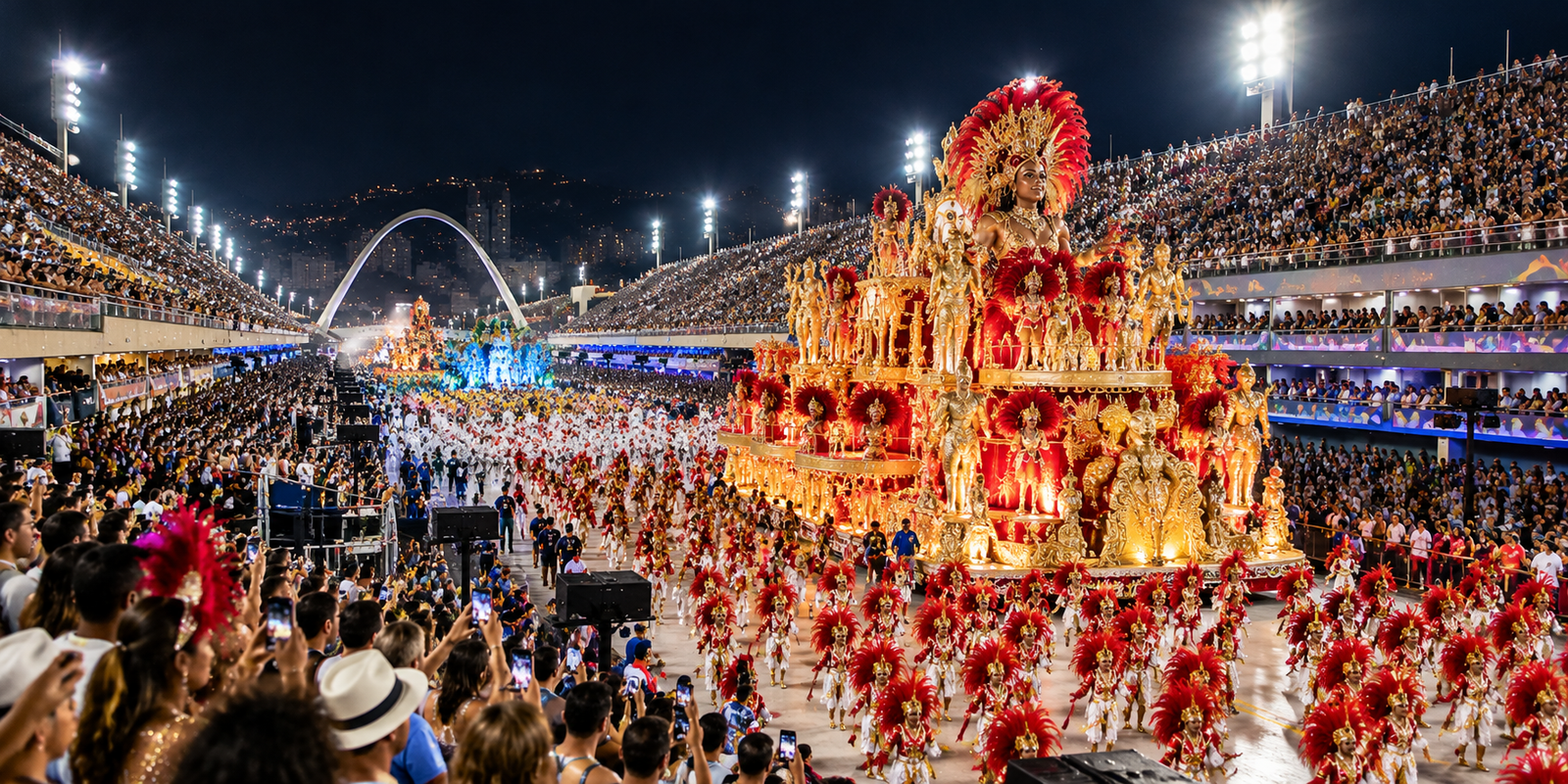
Rio’s Sambadrome is a permanent parade venue, rather than an ordinary street temporarily converted into a Carnival route. Its grandstands run along a long, straight avenue designed specifically for presenting competitive samba-school parades.
Officially named the Passarela Professor Darcy Ribeiro, the Sambadrome stands on Rua Marquês de Sapucaí, in the Cidade Nova area of central Rio de Janeiro. Locally, it is commonly referred to simply as Sapucaí.
The complex was designed by Brazilian architect Oscar Niemeyer and inaugurated in 1984. Its purpose-built arrangement allows samba schools to present enormous decorated floats, percussion sections, dancers and formations before spectators seated on both sides of the avenue.
Unlike a circular stadium, the Sambadrome has a linear layout. Performers progress in one direction, passing successive viewing sectors before reaching the end of the parade route.
This arrangement is essential to understanding the experience: a spectator does not see the entire parade simultaneously. Different elements of each school’s procession arrive, perform and continue past the selected viewing position.
Parade entrance
Concentração
The staging and assembly area where a samba school gathers its performers and floats before entering the competition avenue. This is not the normal public spectator entrance.
Main avenue
Passarela do Samba
The parade route along which competing schools present their samba-enredo, costumes, choreography, percussion and floats to judges and spectators.
Parade completion
Dispersão & Apoteose
The final portion of the route leads toward the Praça da Apoteose, where participants and floats clear the avenue. Spectators should not confuse it with the school assembly area.
Understanding the competition
How Does a Rio Carnival Samba Parade Work?
Each samba school presents a complete themed performance called a desfile. It is not simply a sequence of dancers wearing costumes: music, visual storytelling, precision, movement and competitive rules all shape what the audience sees.
Before Carnival, each school develops an enredo, the central story or subject of its presentation. The school then prepares the samba-enredo, a specially composed song expressing that story.
Costumes, allegorical floats, dance formations and musical arrangements are designed around the same theme. During the parade, the school moves down Sapucaí while the samba-enredo is performed continuously.
Different sections of the school follow a planned order. Their presentation must balance theatrical impact with the practical requirement to keep a very large procession moving through the avenue.
The Opening Presentation
The comissão de frente is the school’s opening commission, traditionally responsible for introducing the parade and welcoming the public through a choreographed performance.
It can include elaborate theatrical devices, dramatic staging and transformations. Judges evaluate this element separately from the other parade components.
Allegorical Floats and Decorations
The enormous structures moving through the avenue are called carros alegóricos. Their decorations, artistic construction and narrative role form an important part of the school’s presentation.
The abre-alas is generally the first major allegorical float, introducing the visual identity of the parade. Later floats develop different parts of the school’s chosen story.
Costumed Wings of Performers
An ala is a coordinated group of participants wearing costumes designed for a particular element of the theme. A single school includes numerous alas.
Their appearance, choreography and positioning form a connected visual narrative. What may appear to be decorative costumes often represents particular people, concepts, historical moments or symbols within the enredo.
The Percussion Section
The bateria is the percussion orchestra that drives the samba rhythm. Instruments commonly include surdos, caixas, repiniques, tamborins, chocalhos and agogôs.
Led by its musical directors, including the mestre de bateria, the ensemble executes rhythmic arrangements and breaks known as paradinhas.
Schools commonly use a dedicated recuo da bateria, a recessed area where the percussion group moves aside temporarily while other parts of the procession continue.
The School’s Flag-Bearing Couple
The porta-bandeira carries the school’s flag, while the mestre-sala performs alongside her through a specialized ceremonial dance. Their movements are distinct from ordinary samba dancing.
The couple is judged on a dedicated criterion. Their presentation gives visitors an opportunity to see one of the most formal and symbolic traditions of the samba-school competition.
Traditional and Individual Performers
The ala das baianas is an important traditional wing, recognizable by its distinctive wide-skirted costumes. It expresses the cultural memory and heritage of samba.
Passistas are skilled samba dancers whose individual technique and expressiveness contribute to the parade’s energy. The different roles should not be confused, even though both are visually memorable.
The spectator experience
What Is It Like to Watch the Parade?
From the grandstands, spectators see an evolving procession rather than a single stage performance. A parade begins with one school’s opening presentation and continues as wings, percussion and floats move into view.
The sound is a defining feature: the samba-enredo plays repeatedly, with the bateria providing a powerful rhythmic foundation. Spectators frequently sing along with the school as it passes.
The physical perspective matters. Higher positions provide a wider view of the parade’s formations. Lower positions make it easier to see performers’ expressions and costume details.
The entire spectacle is presented across several hours, with multiple schools appearing during each competition night. Visitors should expect a long evening, not a brief theatrical performance.
Choosing your position
Rio Sambadrome Sectors Explained
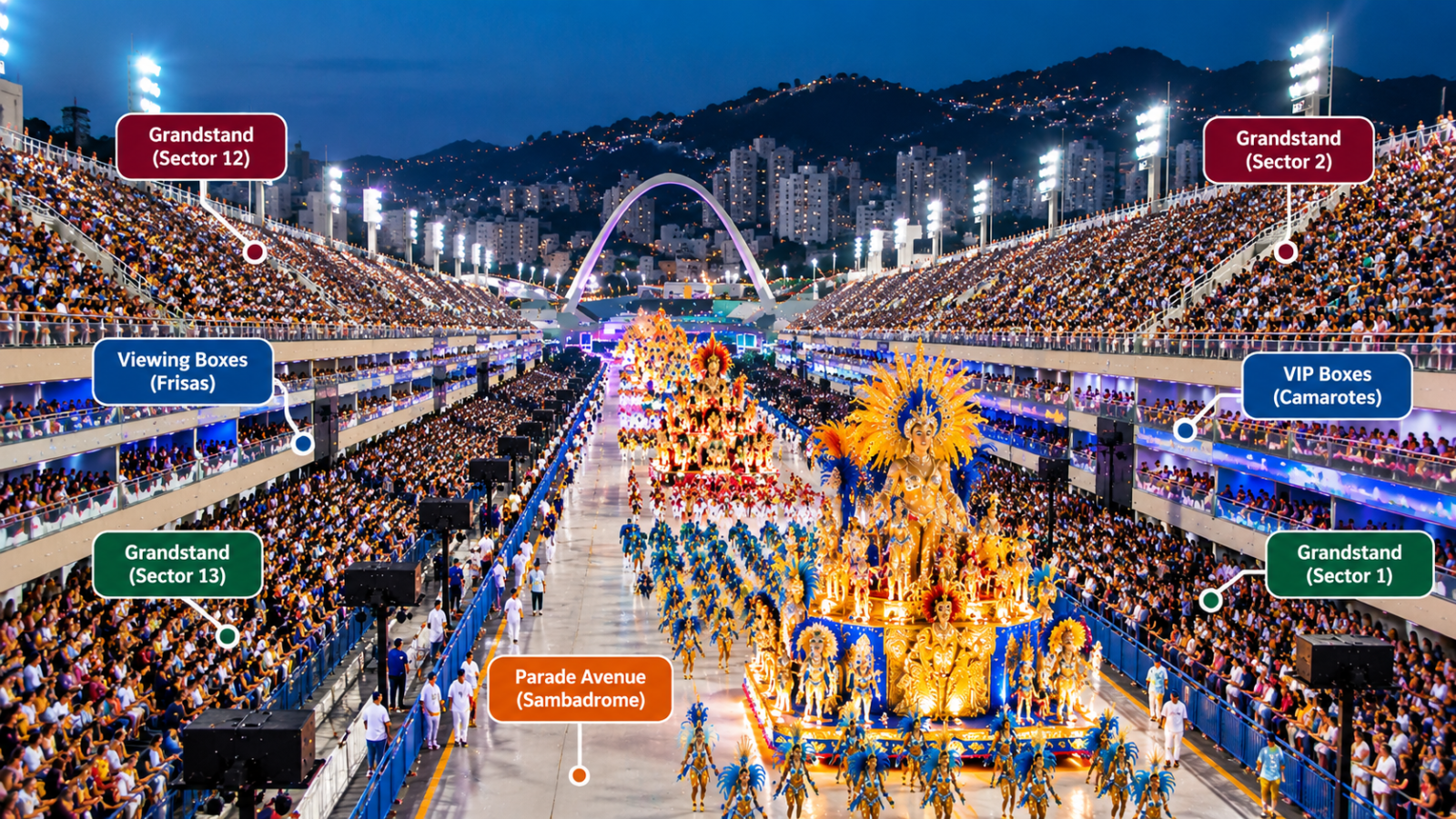
The Sambadrome is divided into numbered sectors arranged along both sides of the parade avenue. Understanding the numbers and their position along Sapucaí is essential before choosing where to watch.
In general, even-numbered sectors are on one side of the parade avenue, with odd-numbered sectors on the opposite side. As the sector numbers increase, the viewing areas progress toward the far end of the parade route.
The important distinction is not simply whether a sector is odd or even. It is whether you want to watch the school near the beginning, around the middle or toward the end of its performance.
Simplified diagram for understanding sector numbering only; not to scale. Sector 1 and individual entrances, access routes, boxes and specialized seating areas are not shown. Always identify the exact sector and admission category on your ticket.
Which Part of the Avenue Should You Choose?
| Area | Viewing characteristics | Best suited to |
|---|---|---|
|
Earlier sectors
Approximately 2–5 |
See elements of the school relatively soon after they enter the parade avenue. You experience the procession in its opening phase. | Visitors interested in the initial presentation and viewing formations relatively early in their progression. |
|
Central sectors
Approximately 6–9 |
A central position along the route. These sectors offer a useful perspective for watching formations develop as the school progresses. | First-time spectators looking for a balanced view of the overall procession. |
|
Later sectors
Approximately 10–13 |
Watch the school farther along its route as it approaches the end of the presentation. Available admission formats vary. | Visitors who prefer watching the later stage of each school and are comfortable with the available seating configuration. |
Compare the spectator areas
Grandstands, Frisas, Chairs and Camarotes
A sector number identifies a general location, but the admission category determines whether you watch from elevated seating, a box close to the avenue, an individually assigned chair or a hospitality enclosure.
01 · Arquibancadas
Grandstands
The arquibancadas are elevated spectator stands positioned along the parade avenue. They offer a broad perspective that is particularly useful for viewing large formations and decorated floats.
Some grandstand areas use general-admission arrangements rather than individually allocated seats. Other sections have specific assigned formats.
Experience: energetic crowd atmosphere, elevated views and considerable interaction with the music and surrounding spectators.
02 · Frisas
Front Boxes
Frisas are small grouped spectator enclosures positioned close to the parade level, in front of the higher grandstand areas.
They provide a more intimate perspective on costumes, movement and passing performers. Viewing height and placement depend on the particular row.
Experience: strong proximity to the parade, with a narrower overall perspective than that available from higher grandstand positions.
03 · Cadeiras Numeradas
Individually Numbered Chairs
Numbered chairs provide an assigned individual seating position. At the Rio Sambadrome, Sector 12 is particularly associated with this admission arrangement.
They suit visitors who prefer knowing their allocated position rather than choosing a place within a general-admission section.
Experience: a defined seat and a different perspective from the elevated unreserved grandstands.
04 · Camarotes
Hospitality Boxes and Lounges
Camarotes are hospitality areas that may include dedicated service spaces and additional amenities. Their layout and viewing arrangements are specific to the operator and location.
Some focus on a direct view of the parade, while others combine Carnival viewing with a separate hospitality or entertainment environment.
Experience: more facilities, though the precise view and included services must be assessed individually.
Different competitive divisions
Special Group, Série Ouro and Champions’ Parade
Not every night at the Sambadrome presents the same competition. The event category determines which schools perform, the competitive context and the nature of the spectacle.
Grupo Especial
Special Group
The highest division of Rio’s samba-school competition, administered by LIESA.
The schools compete through elaborate thematic presentations and are evaluated under the competition’s judging rules.
The 2027 edition features 12 Special Group schools, with four schools appearing on each competition night.
Série Ouro
Gold Series
The Série Ouro is the division immediately below the Special Group. It has its own championship and promotion opportunities.
Its schools also present complete themed parades at Sapucaí, including floats, costumes, percussion and organized wings.
It is a genuine competitive Carnival experience, not a rehearsal or an exhibition.
Desfile das Campeãs
Champions’ Parade
The Champions’ Parade follows the main Special Group competition. The highest-ranked schools return to perform.
Unlike the preceding nights, the main ranking has already been determined.
Visitors experience performances from the successful schools in a celebratory setting, rather than the original competition itself.
For exact competition dates, confirmed school running orders and annual event details, see Rio Carnival 2027.
Understanding the competitive spectacle
How Are Rio Carnival Samba Parades Judged?
The Special Group championship is decided through nine judging categories, known in Portuguese as quesitos. The overall result reflects much more than the size or appearance of the school’s floats.
Judges evaluate specific components of each presentation according to the competition’s approved annual judging manual. The exact procedures and penalties are governed by the regulations for that edition.
| Judging category | What the audience should notice |
|---|---|
| Bateria | The percussion ensemble’s rhythmic performance, precision and execution. |
| Samba-Enredo | The school’s specially composed Carnival song, including its musical and lyrical qualities. |
| Harmonia | The relationship between the school’s participants and the musical performance, including collective singing. |
| Evolução | How the school advances along the avenue, maintaining the required flow and cohesion. |
| Enredo | The coherence and development of the school’s chosen story throughout the parade. |
| Alegorias e Adereços | The artistic construction, visual execution and thematic presentation of floats and allegorical elements. |
| Fantasias | The design, finish and thematic suitability of the performers’ costumes. |
| Comissão de Frente | The school’s opening commission and the quality of its choreographed presentation. |
| Mestre-Sala e Porta-Bandeira | The formal dance and performance of the school’s flag-bearing couple. |
Why Can a Spectacular Parade Lose Points?
Spectacular visual effects alone do not guarantee a championship. A school can present impressive floats and still receive weaker marks in other categories.
The performance of its bateria, the execution of the samba-enredo, the movement of participants and the consistency of the story are all important.
Operational requirements also matter. The rules establish how a school must complete its passage through the avenue, including timing and other requirements.
Spectators watching for the first time often focus on the enormous floats. Observing the flag-bearing couple, listening to the bateria and noticing how smoothly the wings move provides a much fuller understanding of the competition.
Arriving at the correct side
Getting to the Rio Sambadrome
The Sambadrome is located in central Rio de Janeiro, not beside Copacabana or Ipanema beaches. The most important practical detail is identifying which side of the parade avenue your sector occupies.
Even-numbered sectors
Praça Onze Metro
Praça Onze is the principal metro station used for access to the even-numbered side of the Sambadrome.
These sectors include 2, 4, 6, 8, 10 and 12.
Follow the event-specific pedestrian signs and access instructions for the sector printed on your ticket.
Odd-numbered sectors
Central do Brasil
Central do Brasil is the principal station used for approaching the odd-numbered side of the parade avenue.
These sectors include 3, 5, 7, 9, 11 and 13.
The station connects with metro and suburban rail services. Follow the authorized route for your particular entrance.
Metro, Taxi and Ride-Hailing Arrangements
Metro is generally a practical way to reach the Sambadrome because road restrictions affect surrounding streets on parade nights. Special service hours are normally organized for major Carnival events; the operating plan for your date should be checked before departing.
Taxis and ride-hailing vehicles may not be able to drop passengers directly outside their selected entrance. Temporary restrictions can require passengers to complete part of the journey on foot.
After the parades, large groups of spectators may leave simultaneously. Use the authorized pedestrian routes and transport points operating for that night.
Do not assume that the shortest route shown on a normal weekday remains open during Carnival.
Practical Sambadrome information
What First-Time Parade Spectators Should Know
01 · Timing
Expect a Long Night
A Sambadrome competition evening involves several schools appearing in succession. The complete programme may continue into the early morning.
Plan around the full event rather than the appearance of only one school, unless you deliberately intend to attend a shorter part of the night.
02 · Comfort
Prepare for Outdoor Conditions
Many viewing areas are open to Rio’s summer weather. Heat, humidity and sudden rain are possibilities, even during evening events.
Comfortable clothing and practical footwear are sensible. Check the current venue rules before bringing umbrellas, large bags or other items.
03 · Food and facilities
Understand Your Viewing Category
Food, drinks and restroom arrangements depend partly on the area in which you are watching.
Do not assume hospitality amenities are included with ordinary grandstand admission. Some services may involve additional purchases.
04 · Photography
Choose Your Viewing Perspective
Elevated grandstand positions are useful for photographing formations and large floats. Lower viewing positions emphasize individual costumes and passing performers.
Keep equipment manageable, avoid obstructing other spectators and verify restrictions on professional cameras or related accessories.
05 · Admission
Understand Sector Boundaries
A ticket for one sector does not normally provide unrestricted access throughout the Sambadrome.
Public circulation areas, hospitality enclosures and specialized spectator sections are controlled separately.
06 · Accessibility
Confirm Accessible Arrangements
Travelers requiring accessible seating, step-free entry or specific assistance should establish the arrangements for their selected sector before purchasing admission.
Do not assume that every grandstand position has identical accessibility. Access routes and facilities vary by location.
Matching the event to your interests
Which Sambadrome Parade Experience Should You Choose?
Select a parade by the kind of Carnival performance you want to see, not only by the sector or viewing category.
For the main competition
Special Group
Choose a Special Group night if your priority is the top-level competition, with Rio’s leading schools presenting their major annual parade productions.
For competitive variety
Série Ouro
Choose Série Ouro to see ambitious, complete samba-school performances within a distinct competitive division. It is an important part of Rio’s Carnival structure.
For a post-competition event
Champions’ Parade
Choose the Champions’ Parade if you want to watch the leading finishers return after the championship ranking has already been decided.
If your main interest is learning about the competing organizations, their traditions and identities, continue to the Rio Samba Schools Guide.
Sambadrome questions answered
Frequently Asked Questions
Where is the Rio Carnival parade held?
The main competitive samba-school parades take place at the Sambadrome, officially the Passarela Professor Darcy Ribeiro, on Rua Marquês de Sapucaí in central Rio de Janeiro. This is separate from the street-bloco celebrations held across the city.
Is the Sambadrome the same as Sapucaí?
Yes. Sapucaí is the common shorthand for the Marquês de Sapucaí Sambadrome. Both names refer to the principal samba-school parade venue in Rio.
How long is the Sambadrome parade avenue?
The purpose-built Sambadrome complex extends for approximately 700 metres. Samba schools progress along the parade route from their assembly area toward the dispersal area near Praça da Apoteose.
Can spectators walk between Sambadrome sectors?
Admission is controlled by sector and viewing category. Spectators should not assume they can move freely between numbered sectors or cross from one side of the avenue to the other after entry.
Are grandstand seats assigned?
Not all grandstand categories operate in the same way. Many use general-admission arrangements, while certain seating categories provide individually allocated places. Check the exact category stated on the admission offer.
What is the difference between the Special Group and Série Ouro?
The Special Group is the highest division of Rio’s samba-school competition. Série Ouro is the division below it, with its own championship and promotion system. Both organize complete competitive parades at the Sambadrome.
Can visitors participate in a samba parade?
Participation as a performer is different from attending as a spectator. Visitors wishing to parade must arrange participation through an appropriate samba-school or authorized costume and participation arrangement. An ordinary spectator ticket does not authorize entry into the parade procession.
Which metro station serves the Sambadrome?
Praça Onze is normally used for even-numbered sectors, while Central do Brasil is normally used for odd-numbered sectors. Follow the event-specific transport and entrance instructions for your ticket.
Is the Sambadrome parade suitable for first-time visitors?
Yes, provided visitors select a suitable viewing category and plan for the event’s duration, crowd levels, transport and overnight schedule. A central elevated grandstand position can offer a useful first introduction to the overall spectacle.
Does every samba school perform on every Carnival night?
No. Each competitive samba school receives a particular date and running position within its division’s programme. The Champions’ Parade later features qualifying schools from the Special Group.
Continue exploring Rio Carnival
Plan Your Sambadrome Experience
Explore the detailed guides for event dates, viewing admission, competing samba schools and practical travel arrangements.