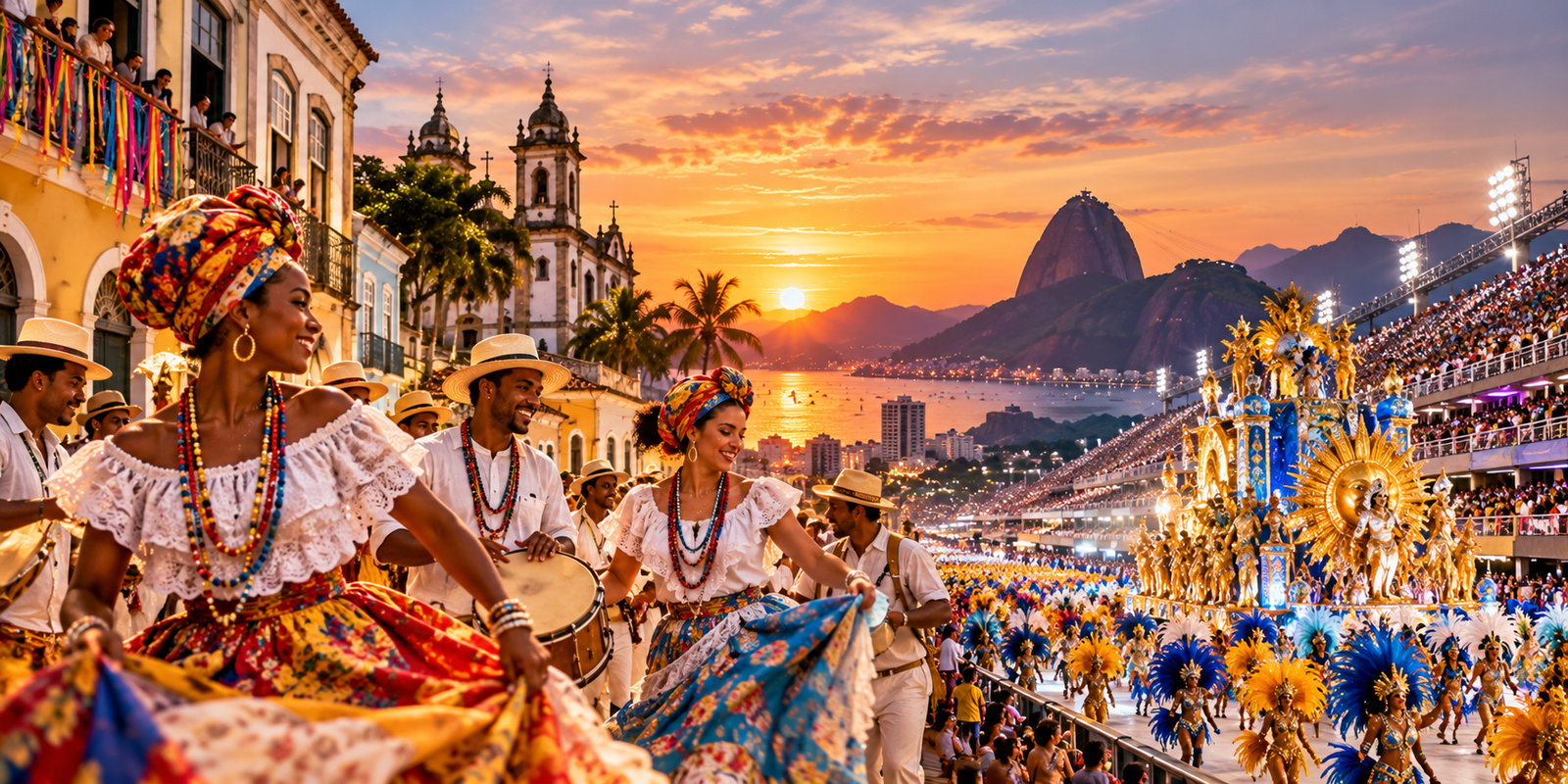
Rio de Janeiro · Carnival Heritage & Culture
History of Rio Carnival: From Street Celebrations to Samba
Discover how centuries of popular celebration evolved into Rio’s extraordinary Carnival. Explore Portuguese Entrudo, Afro-Brazilian musical traditions, the first samba schools, the growth of competitive parades and the creation of the Sambadrome.
Understanding the Festival’s Origins
How Did Rio Carnival Begin?
Rio Carnival did not begin with the samba schools or the Sambadrome. Its history stretches back through colonial-era pre-Lenten festivities, 19th-century street celebrations and the cultural traditions of Afro-Brazilian communities.
Carnival’s position in the calendar comes from the Christian period preceding Lent. European celebrations before Lent were brought to Brazil through Portuguese colonization, but the festival that developed in Rio was never merely a copy of a European event.
Over time, Rio’s celebrations incorporated local traditions, music, social commentary, neighborhood organizations and the creativity of communities whose contributions shaped the city’s cultural identity.
The modern Carnival therefore has several connected histories: the history of public street festivities, the history of samba as a musical and social practice, and the history of organized competitive parades.
These traditions overlap, but they did not develop in precisely the same way or at the same time. Understanding that distinction helps explain why Rio Carnival still includes free street blocos, community samba-school events and highly organized Sambadrome competitions.
Rio Carnival is not one tradition invented on a single date. It is the result of generations of cultural exchange, creativity, community organization and change.
The central story of Rio CarnivalBefore the Samba Schools
Entrudo, Masked Balls and Carnival Societies
The Portuguese Entrudo
One of the important early forms of Carnival in colonial Brazil was Entrudo, a festive practice with Portuguese roots. It commonly involved playful confrontations using water and other materials.
Entrudo could be lively and disruptive. Authorities and socially influential groups increasingly objected to aspects of these public celebrations. Their attempts to regulate Carnival helped create a distinction between street festivities and more controlled entertainments.
Entrudo was not the same as the samba-centered Carnival familiar today. There were no modern samba-school championships, no purpose-built parade avenue and no unified Carnival programme.
Masked Balls and the Grandes Sociedades
During the 19th century, masked balls, organized outings and elaborate costumed processions became important parts of Rio’s Carnival culture.
In 1855, the Congresso das Sumidades Carnavalescas held an influential organized Carnival procession. It became an important landmark in the development of the grandes sociedades, or large Carnival societies.
These organizations were often associated with the city’s more affluent social groups. Their elaborate costumes, carriages and public displays differed from celebrations organized by working-class and Afro-Brazilian communities.
The contrast reflected the social divisions of the period. Carnival was a shared urban occasion, but participation, public visibility and access to resources were far from equal.
Ranchos, Cordões and Popular Processions
Popular Carnival associations developed alongside the grandes sociedades. These included ranchos, cordões and early neighborhood Carnival groups.
Ranchos were particularly important because they introduced organized processions with distinctive music, costumes, banners and group roles. Their structures influenced the later development of samba-school presentations.
Hilário Jovino Ferreira, a musician with connections to Bahia, is associated with the creation of the Reis de Ouro rancho in 1894. His contribution illustrates how cultural traditions moved between Brazilian regions and were transformed in Rio.
The modern samba-school parade did not simply replace every earlier Carnival form. It inherited and adapted elements from these different public celebrations.
The Music That Transformed Carnival
How Did Samba Become the Sound of Rio Carnival?
Samba developed through the musical, social and cultural practices of Afro-Brazilian communities. Its emergence in Rio cannot be separated from the experiences of Black Brazilians, the legacy of slavery and the movement of people within Brazil.
In the late 19th and early 20th centuries, Rio’s growing population included many migrants from Bahia, whose musical and religious traditions contributed to the city’s developing samba culture.
Houses, courtyards, social gatherings, religious spaces and neighborhood celebrations were central to this process. Samba was sustained through relationships between musicians, dancers, families and community members.
The music drew from multiple traditions, including samba de roda, jongo, maxixe and the broader musical environment of urban Rio. It developed through exchange and innovation, not through the work of a single inventor.
Pequena África and Praça Onze
The area often called Pequena África, or Little Africa, is central to the history of samba in Rio.
Connected with the city’s port region and nearby Black communities, it provided important spaces for musicians, religious practices, festivities and cultural exchange.
Praça Onze became especially significant as a meeting place and later as a setting for early samba-school competitions.
Tia Ciata and the Samba Community
Hilária Batista de Almeida, widely known as Tia Ciata, was an influential Afro-Brazilian cultural figure associated with the early history of samba in Rio.
Her home became known as a gathering place for musicians and members of the wider samba community.
Her significance also reflects the important, sometimes underrecognized, role of Black women in sustaining cultural traditions and community networks.
The Importance of “Pelo Telefone”
The song Pelo Telefone, registered in 1916 and widely popular during Carnival 1917, occupies a major place in samba’s recorded history.
It is commonly described as an early landmark in the commercialization and wider public recognition of samba.
However, identifying it as the single first samba would oversimplify the history of a musical tradition that had already developed through collective practice.
Its authorship and musical origins have also been discussed and contested by historians and musicians. The song’s importance lies partly in the visibility it brought to samba at a time when the music was moving into wider urban and commercial circulation.
The Birth of a New Carnival Institution
When Were the First Rio Samba Schools Founded?
The modern samba-school movement began taking recognizable shape during the 1920s. Neighborhood musicians and Carnival groups developed organizations that combined music, local identity and coordinated public performance.
The Estácio neighborhood played an especially important role in the transformation of samba’s rhythm. Musicians associated with Estácio developed a more processional style, better suited to groups singing and moving together.
Figures associated with these developments included Ismael Silva, Bide and Nilton Bastos, among others. Their musical innovations helped establish a rhythmic approach that would become fundamental to samba-school parades.
Deixa Falar and the Meaning of “Samba School”
Deixa Falar, founded in Estácio in 1928, is frequently recognized as the pioneering samba school.
Historians distinguish that important pioneering role from the question of whether any one organization was absolutely the first group ever to use the term escola de samba.
Other Carnival associations already existed and contributed to the movement’s development. The formation of samba schools was a gradual process rather than the result of one isolated event.
The expression “samba school” refers to an organization that cultivates and presents samba traditions. It does not mean the same thing as a conventional school offering dance classes.
Portela, Mangueira and Community Identity
The development of Portela in the Oswaldo Cruz and Madureira area, and Estação Primeira de Mangueira in the Mangueira community, illustrates how samba-school identity became closely tied to neighborhoods and supporters.
Portela traces its origins to 1923, while Mangueira was founded in 1928. Both would become major institutions in the history of competitive Carnival.
Over time, the schools established recognizable colors, emblems, musical traditions and networks of members and supporters.
Their significance extended beyond winning competitions. They became enduring cultural organizations through which communities expressed belonging, memory and identity.
Major Historical Milestones
Rio Carnival History Timeline
These milestones show how Rio’s Carnival developed from pre-Lenten street celebrations into a major cultural institution with organized samba-school competitions and a permanent parade venue.
Entrudo and Early Festivities
Portuguese-influenced pre-Lenten celebrations became part of life in colonial Brazil. Street play, particularly Entrudo, preceded the musical Carnival formats known today.
Organized Carnival Societies
The Congresso das Sumidades Carnavalescas held a landmark procession, representing the growth of organized, elaborate Carnival societies.
Development of the Ranchos
The Reis de Ouro rancho, associated with Hilário Jovino Ferreira, became an important landmark in the development of organized popular Carnival processions.
Samba Gains Wider Recognition
Pelo Telefone became a major Carnival success, marking an important moment in the broader public circulation of samba.
Deixa Falar and the Early School Movement
Deixa Falar was founded in Estácio and became a landmark in the history of samba schools. Mangueira also emerged during this period.
First Major Competitive School Parade
The newspaper Mundo Sportivo organized a competition at Praça Onze. Nineteen schools participated, with Mangueira declared the winner.
Municipal Recognition
Samba-school parades gained formal municipal recognition and public financial support, strengthening their position in Rio’s Carnival calendar.
Parades Move as the City Changes
Urban redevelopment transformed the Praça Onze area and the parade locations changed. Rio Branco and Presidente Vargas became important avenues in the competition’s history.
A New Visual and Artistic Era
Artists and designers, including Fernando Pamplona at Salgueiro, helped develop a more integrated visual language and brought greater prominence to Afro-Brazilian themes.
Parades Arrive at Marquês de Sapucaí
The main competition moved to Marquês de Sapucaí before the permanent Sambadrome existed. Temporary structures still accommodated spectators.
The Sambadrome Opens
Oscar Niemeyer’s permanent parade complex, officially named Passarela Professor Darcy Ribeiro, opened for Carnival.
Samba Heritage Receives National Recognition
Three traditions — partido-alto, samba de terreiro and samba-enredo — were registered by Brazil’s heritage institute, IPHAN, as intangible cultural heritage.
Sambadrome Modernization
The venue’s major renovation completed an expansion that brought the grandstands closer to Niemeyer’s original symmetrical design.
Pandemic Disruption and Return
The COVID-19 pandemic interrupted Carnival’s customary event schedule. The competitive parades returned in April 2022, while the usual street-bloco programme was not held that year.
Continuing Recognition of Samba
IPHAN approved the revalidation of the national cultural heritage registration for Rio’s three recognized samba traditions, reflecting their continuing cultural importance.
From Neighborhood Parade to Competition
How Did the Samba-School Parades Become a Championship?
The first samba-school performances were much smaller than modern Sambadrome productions. They developed from neighborhood processions into increasingly structured events with judges, rankings and defined performance requirements.
In 1932, the newspaper Mundo Sportivo, directed by Mário Filho, organized a competitive samba-school parade at Praça Onze. Mangueira won the contest.
The success of these early events encouraged further competitions. Municipal support from 1935 contributed to the schools’ growing recognition as an important part of Rio’s Carnival.
Early parades were relatively short, and their songs, costumes and visual elements were not always coordinated around one detailed story.
Over subsequent decades, the connection between the enredo (parade theme), samba-enredo (thematic samba song) and visual presentation became increasingly important.
A modern samba-school production depends on several connected elements: musical performance, choreography, costume construction, allegorical floats and disciplined movement along the avenue.
Community Processions
Smaller school groups, locally organized music and relatively simple presentations were central to the early contests.
Themed Productions
Themes, samba songs, costumes and allegorical elements became increasingly connected within each presentation.
Complex Competitive Parades
Schools now coordinate large artistic and musical productions under detailed judging and timing regulations.
The Role of Artists and Carnival Designers
The modern visual language of Carnival owes much to generations of artists, craftsmen and creative directors working alongside samba communities.
In the late 1950s and early 1960s, Salgueiro became especially influential in developing an innovative artistic approach. Figures such as Fernando Pamplona helped transform the thematic and visual possibilities of the parade.
This included greater attention to subjects drawn from African and Afro-Brazilian history, challenging the dominance of more conventional historical narratives.
Later designers continued expanding the scale and sophistication of the parade, turning its visual presentation into an increasingly important artistic field.
A Permanent Home for the Parade
History of the Rio Sambadrome
The Sambadrome opened in 1984, but samba schools had been competing on Rio’s streets for more than five decades. Its construction marked a major change in the organization and presentation of Carnival.
Before the permanent complex was constructed, large temporary structures were assembled for the annual parades. Their location changed as the city developed and the competition grew.
The move to Marquês de Sapucaí in 1978 established the avenue that would later become the home of the Sambadrome.
Architect Oscar Niemeyer designed the Passarela Professor Darcy Ribeiro during the administration of Rio de Janeiro state governor Leonel Brizola. Darcy Ribeiro played a central role in advancing the project.
Built rapidly in preparation for Carnival 1984, the complex provided a permanent linear stage for samba-school competitions.
Its design placed grandstands along the parade avenue, with the procession advancing toward the distinctive Praça da Apoteose.
Oscar Niemeyer’s Design
The Sambadrome reflects Niemeyer’s distinctive modernist use of concrete, dramatic structural forms and monumental space.
The project also incorporated an educational purpose, with classroom spaces designed beneath sections of the grandstands.
Grandstand Expansion
A major renovation replaced structures on one side of the avenue and added new grandstands.
The changes helped realize a more symmetrical arrangement envisaged in Niemeyer’s original architectural design.
For the present-day venue layout, grandstands and viewing positions, continue to the Rio Sambadrome & Parades Guide.
The Celebration Beyond the Grandstands
The History and Revival of Rio Street Carnival
Street Carnival is not a recent alternative to the Sambadrome. Public street festivities existed long before samba schools, although their forms, scale and organization have changed repeatedly.
During the 19th and early 20th centuries, Carnival included popular processions, cordões, ranchos, bands and neighborhood associations.
Some organizations survived for many decades, adapting their traditions to a changing city.
Cordão da Bola Preta, founded in 1918, remains one of Rio’s best-known historic Carnival groups. Banda de Ipanema, founded in 1965, became another important symbol of Rio’s street celebrations.
While the competitive samba-school parades gained enormous visibility during the 20th century, street festivities continued to evolve in parallel.
From the late 20th century into the 2000s, Rio experienced major growth in street-Carnival activity, with new and revitalized bands and blocos occupying public spaces.
This expansion introduced new musical approaches while reconnecting audiences with older Carnival practices.
It also created practical challenges involving crowd management, transport, authorization and the use of public streets.
Traditional Bands and Cordões
Long-established groups preserve music, costumes, humor and processional traditions that connect present-day Carnival with earlier generations.
Their identities often belong to particular neighborhoods, communities or musical traditions.
New Music and Expanding Blocos
Contemporary street Carnival includes traditional marchinhas, samba, brass bands, percussion ensembles and other musical influences.
Its growth has expanded Carnival into a longer season of events spread across numerous parts of Rio.
Discover the present-day street celebrations, their musical identities and major groups in the Rio Street Carnival & Blocos Guide.
Cultural Recognition and Living Traditions
Why Is Rio Carnival Culturally Important?
Rio Carnival is significant not only because of its scale, but because its music, organizations and artistic traditions carry the histories of the communities that created them.
In 2007, Brazil’s national heritage institute, IPHAN, recognized three major samba traditions associated with Rio: partido-alto, samba de terreiro and samba-enredo.
These traditions were entered in the national register of intangible cultural expressions. The recognition reflects their importance as practices transmitted through communities, music, social gatherings and samba schools.
Improvisation and Participation
Partido-alto is distinguished by improvised verses, rhythmic exchange and interaction within a musical gathering.
The skill lies not only in performing a song, but in responding creatively within a shared tradition.
Community Musical Life
Samba de terreiro is associated with the musical practices of community spaces, rehearsal halls, courtyards and gatherings.
It reflects the social life and cultural memory of samba communities outside formal competition nights.
Music for the Parade Story
Samba-enredo provides the musical narrative for a samba school’s annual Carnival theme.
Its melody, lyrics and repeated performance help connect the school’s participants and visual presentation.
The Importance of Cultural Preservation
Carnival knowledge is passed down through generations of musicians, dancers, craftspeople, composers, organizers and community members.
The skills behind a major parade include percussion, singing, costume-making, float construction, choreography and detailed artistic planning.
These traditions cannot be understood only through the final spectacle. Rehearsals, community events and cultural education are also important to their continuity.
In March 2025, the national heritage recognition of Rio’s samba traditions was revalidated, acknowledging their continuing significance as living cultural expressions.
A Tradition That Continues to Change
Rio Carnival in the 21st Century
Modern Rio Carnival combines historic cultural traditions with increasingly complex artistic production, media coverage, international tourism and citywide event organization.
The competitive parades involve extensive preparation long before the Carnival period. Samba schools organize musical competitions, community rehearsals and major costume and float production.
Meanwhile, street Carnival has expanded into a broad programme of neighborhood gatherings, traditional blocos and major public events.
The COVID-19 pandemic demonstrated how significantly Carnival can be affected by wider events. The usual 2021 celebrations were disrupted, and the 2022 samba-school competitions took place in April rather than the ordinary pre-Lenten period.
The regular street-bloco programme was not held in 2022. The return of Carnival activity in subsequent years became an important chapter in the festival’s recent history.
Today, Carnival continues to balance artistic ambition, community identity, public celebration, economic pressures and the practical demands of hosting large numbers of visitors.
Its history is therefore not complete. Each new generation of composers, performers and organizers contributes to the changing character of the celebration.
The most important continuity in Rio Carnival is not the size of its floats or the architecture of the Sambadrome. It is the creativity of the communities that keep its music and traditions alive.
Rio Carnival’s continuing cultural legacyUnderstanding Carnival Terminology
Key Historical Terms in Rio Carnival
Several Portuguese terms describe different periods and traditions in Carnival’s development. They are not interchangeable.
| Term | Meaning | Historical significance |
|---|---|---|
| Entrudo | Early pre-Lenten public festivities | Important form of Carnival in colonial and 19th-century Brazil |
| Grande sociedade | Organized Carnival society | Associated with elaborate 19th-century processions |
| Rancho | Organized musical Carnival procession | Helped establish elements later adopted by samba schools |
| Cordão | Traditional Carnival group or procession | Part of Rio’s popular street-Carnival heritage |
| Escola de samba | Samba-school cultural association | Central institution in the modern competitive parade |
| Enredo | Parade story or theme | Guides the school’s visual and musical presentation |
| Samba-enredo | Samba composed for the theme | Connects the narrative with the musical performance |
| Quadra | Samba-school rehearsal and community venue | Important space for cultural continuity and musical preparation |
| Sambódromo | Purpose-built parade venue | Permanent competition setting in Rio since 1984 |
| Bloco de rua | Street Carnival group | Connects present-day public celebrations with Rio’s longstanding street traditions |
Rio Carnival History Questions
Frequently Asked Questions
When did Rio Carnival begin?
Rio Carnival developed gradually from colonial-era pre-Lenten festivities, including Entrudo. Organized Carnival societies became prominent in the 19th century, while samba schools emerged during the 1920s. There is no single date on which every aspect of modern Rio Carnival began.
Who invented Rio Carnival?
No single person invented Rio Carnival. It developed through several centuries of cultural exchange and public celebration. Portuguese pre-Lenten practices, Afro-Brazilian traditions, musicians and neighborhood organizations all contributed to its development.
Where did the samba used in Rio Carnival originate?
Rio samba developed through Afro-Brazilian musical and social practices, drawing on traditions carried between Bahia, Rio and other communities. Important environments included gatherings around Pequena África, Praça Onze, Estácio and neighborhoods across the city.
What was the first samba school?
Deixa Falar, founded in Estácio in 1928, is widely regarded as a pioneering samba school. Historians also recognize earlier Carnival associations, making the question of the absolute first organization more complex.
When was the first Rio samba-school competition?
The first major organized competitive samba-school parade took place at Praça Onze in 1932, promoted by the newspaper Mundo Sportivo. Mangueira won that competition. Earlier samba contests had also taken place.
Where did samba schools parade before the Sambadrome?
Samba schools performed in different locations in central Rio, including Praça Onze, Avenida Rio Branco and Avenida Presidente Vargas. The principal competition moved to Marquês de Sapucaí in 1978, before the permanent venue opened.
When was the Rio Sambadrome built?
The Sambadrome was built for Carnival 1984. It was designed by Oscar Niemeyer and named Passarela Professor Darcy Ribeiro. The complex underwent major modernization in 2011–2012.
Why is Praça Onze important to samba?
Praça Onze was an important meeting place in the early history of Rio samba, particularly through its connections with Afro-Brazilian communities and musicians. It also hosted the pioneering samba-school competitions of the 1930s.
Is Rio Carnival part of Brazil’s cultural heritage?
In 2007, Brazil’s heritage institute IPHAN registered three samba traditions associated with Rio — partido-alto, samba de terreiro and samba-enredo — as intangible cultural heritage. That recognition was revalidated in 2025. It specifically concerns these samba traditions, rather than every Carnival activity being one single heritage listing.
Is street Carnival older than the Sambadrome?
Yes. Rio’s street Carnival traditions predate the Sambadrome by many generations. Public festivities, ranchos, cordões and neighborhood processions were established long before the permanent parade venue opened in 1984.
Why did Rio Carnival change so much over time?
Carnival changed as Rio’s population, music, neighborhoods, public spaces and cultural organizations evolved. The establishment of competitions, new artistic practices, broadcasting and the construction of the Sambadrome all influenced its development.
Was Rio Carnival held during the COVID-19 pandemic?
The pandemic disrupted the usual Carnival schedule in 2021 and 2022. Competitive samba-school parades returned in April 2022, while the ordinary street-Carnival programme was not held that year.
Explore the Living Carnival Tradition
From Rio Carnival History to Today’s Celebrations
The music, institutions and public traditions described in this historical guide continue to shape modern Carnival. Explore the present-day experiences in the related guides.